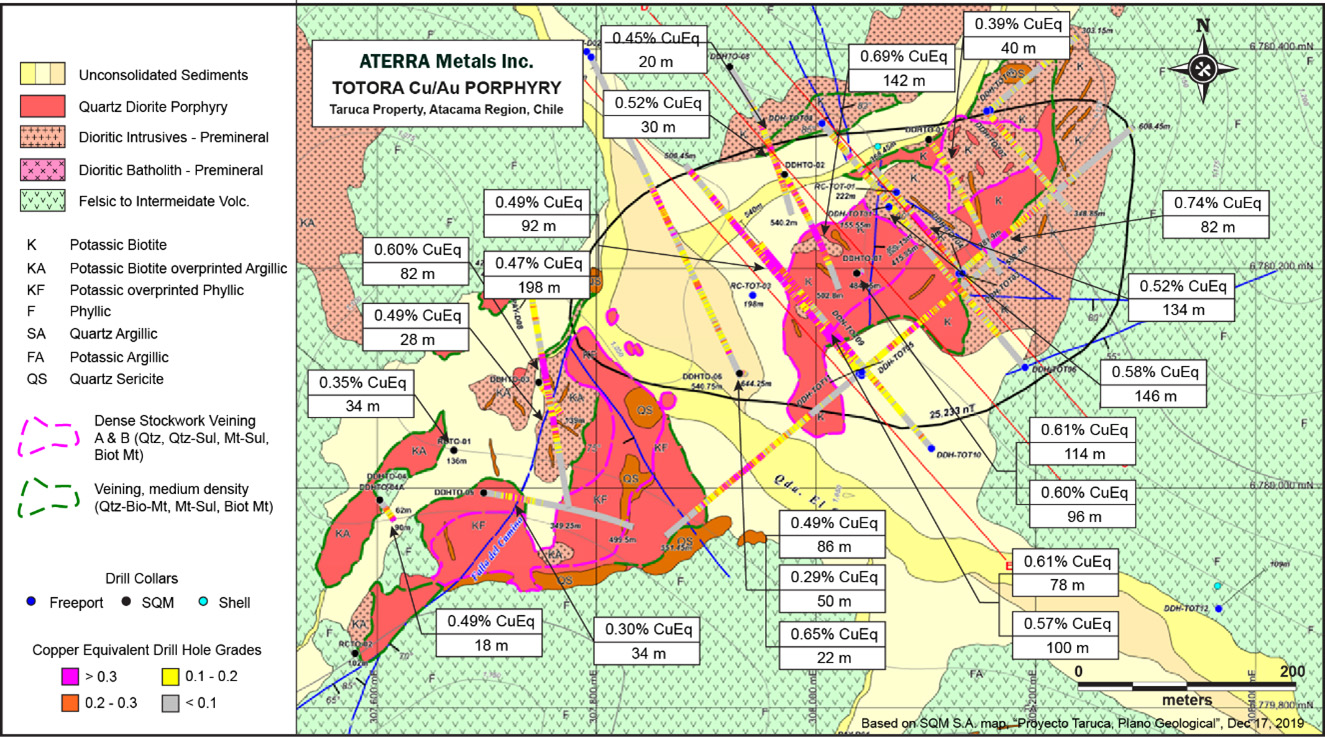
The 1,300-hectare Taruca Property hosts several porphyry targets at various stages of exploration from early (Conico and Conico Sur) to more advanced: the Totora; and Algarrobilla Cu/Au porphyries. Similar to the Clinton porphyry, in the Totora area, a system of multiple porphyry intrusions developed which have generated a sequence of breccias containing Cu-Au mineralization.
The early first intrusive events correspond to a strongly biotitic, dioritic to quartz-dioritic parent porphyry. Subsequently, derived from the parental intrusive, a series of early, intermineral and late porphyries evolved, which make up a Cu-Au-(Mo) porphyry systems of multiple intrusions. Early events, some of which outcrop on the surface, comprise andesitic and dioritic porphyries with hydrothermal alteration of secondary biotite.
Late mineralization events are represented by andesitic and dioritic porphyries exhibiting potassium alteration of biotite, accompanied by silicification. Retrograde alteration of the chlorite-epidote type is restricted.
Taruca Mineralization and Alteration
Mineralization associated with the Totora and Algarrobilla porphyries is dominated by chalcopyrite and trace bornite, with minor gold and molybdenite. Supergene mineralization is scarce with only poorly developed horizons containing oxidized Cu lodged mainly in fractures (turquoise, chrysocolla, brocanthite, and oxidized black Cu), with grades between 0.1-0.5% Cu.
Secondary sulphides, mainly in the Algarrobilla sector, occur as poorly developed horizons, with minor intercepts that reach up to 40 m, whose mineralization corresponds to thin coatings of chalcocite on pyrite, with grades between 0.15-0.70% Cu.
Early porphyries exhibit EB- and A- type veinlet stockworks. The EB-type veinlets are associated with potassic alteration of biotite, whose mineral assemblage corresponds to biotite-magnetite with chalcopyrite-magnetite mineralization and locally bornite. The A-type veining corresponds to granular quartz veinlets with chalcopyrite-magnetite mineralization. The grades present in early porphyries range from 0.2-0.8 g/t Au to 0.4-0.9% Cu.
The intermineral porphyries exhibit mineralized EB-type veinlets (biotite-magnetite), A-type (quartz-chalcopyrite-magnetite), and B-type (quartz-pyrite-chalcopyrite-molybdenite). For Cu-Au intermineral porphyries, mineralization ranges from 0.2-0.6 g/t Au and 0.2-0.6% Cu. In all cases, a large part of the mineralization is associated with potassium alteration of biotite. Late porphyries feature mainly disseminated pyrite mineralization and pyrite-anhydrite veinlets with traces of chalcopyrite.
The Totora and Algarrobilla alteration zones are well defined and correlate with the different lithological types that make up the mineralized system. In the central part of the systems, the intrusion of early porphyries and intermineral intrusives define a zone of potassium alteration of biotite-albite, locally altered to retrograde chlorite. In general, the intensity of this alteration tends to be pervasive and occurs mainly in the matrix of the intermineral igneous breccia system.
In the parental intrusive, the effects of alteration are evidenced by the occurrence of pervasive and partly potassic alteration of biotite to locally completely transforming the primary mafic minerals (amphibole). Late events correspond to silicification accompanied by potassium alteration of biotite plus anhydrite. Locally and restrictedly, there is an overprint of chlorite-epidote alteration.
Totora Cu/Au Porphyry
The Totora porphyry has been the focus of a number of drill programs with approximately 10,140 metres completed (see table below for Totora historical drill assay highlights). Drilling has outlined a structurally controlled, mineralized system traced along a strike length of 800 metres on surface and extending to depths of up to 500 metres downhole. No resource estimate has been completed for the Totora porphyry.
| Totora Historical Drilling Highlights | ||||||
| Drill Hole | From | To | Interval | Cu | Au | Company |
| metres | (%) | (g/t) | ||||
| PAY-08 | 98 | 180 | 82 | 0.17 | 0.34 | Freeport |
| and | 200 | 228 | 28 | 0.33 | 0.12 | |
| DDHTO-02 | 214 | 356 | 142 | 0.47 | 0.17 | SQM |
| including | 214 | 286 | 72 | 0.64 | 0.26 | |
| DDH-TOT-09 | 62 | 154 | 92 | 0.27 | 0.18 | Minera Veinte Norte |
| and | 170 | 368 | 198 | 0.27 | 0.15 | |
| DDHTO-07 | 0 | 114 | 114 | 0.23 | 0.31 | SQM |
| and | 216 | 312 | 96 | 0.41 | 0.15 | |
| DH-TOT10 | 220 | 298 | 78 | 0.34 | 0.22 | SQM |
| and | 374 | 474 | 100 | 0.40 | 0.14 | |
| NOTE: See note on Historical Results and on the calculation of CuEq grades. CuEq grades were composited using a 0.25% cut-off grade and max. 4 metres of internal sub-0.25% CuEq “waste” material. Intervals represent downhole lengths and not true widths. The reader is cautioned against relying on the accuracy of the historical results presented; however, ATERRA considers all historical results to be relevant as those results will be used as a guide to plan future exploration programs: ATERRA considers the data to be reliable for these purposes. | ||||||
Algarrobilla Cu/Au Porphyry
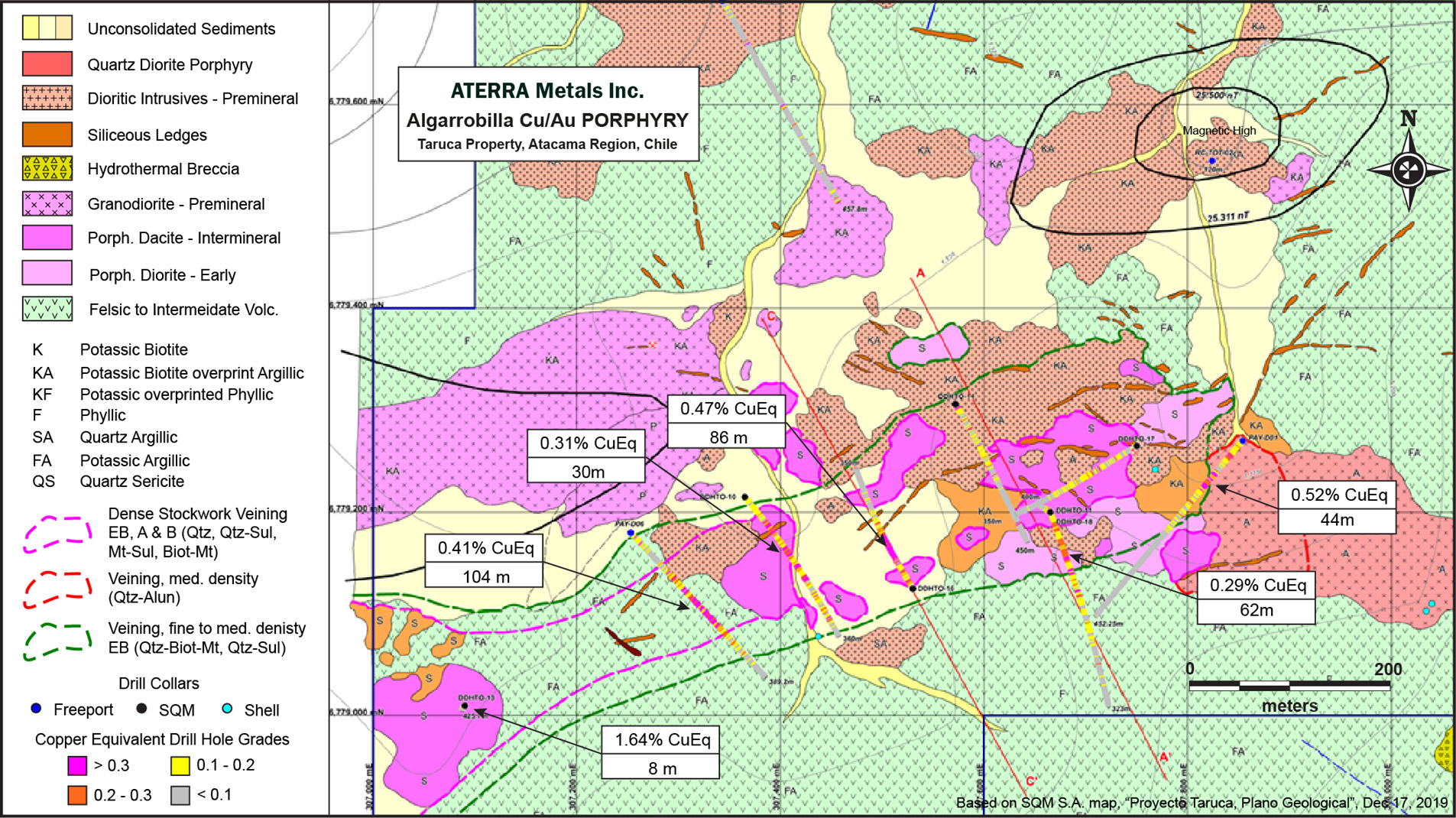
Approximately 1 kilometre south of Totora lies the Algarrobilla porphyry. SQM drilled 3,140 metres during 2018-2019 and Freeport drilled 806 metres in 2014 (see Table below for drill assay highlights). Historical drilling outlined a 700-metre mineralized corridor. No resources are reported. Two bornite-bearing high-grade intervals were intersected at depth in drill hole DDHCL-13 including 8 m grading 1.64% Cu and 0.39 g/t Au suggesting the potential for a higher-grade porphyry at depth. The nearest drill hole to DDHCL-13 300 metres to the northeast.
| Algarrobilla Historical Drilling Highlights | ||||||
| Drill Hole | From | To | Interval | Cu | Au | Company |
| metres | (%) | (g/t) | ||||
| PAY-06 | 150 | 254 | 104 | 0.31 | 0.08 | Freeport |
| DDHCL-13 | 280 | 288 | 8 | 1.14 | 0.39 | SQM |
| DDHCL-16 | 84 | 170 | 86 | 0.33 | 0.11 | SQM |
| NOTE: See notes on Historical Results and on the calculation of CuEq grades. CuEq grades were composited using a 0.25% cut-off grade and max. 4 metres of internal sub-0.25% CuEq “waste” material. Intervals represent downhole lengths and not true widths. The reader is cautioned against relying on the accuracy of the historical results presented; however, ATERRA considers all historical results to be relevant as those results will be used as a guide to plan future exploration programs: ATERRA considers the data to be reliable for these purposes. | ||||||