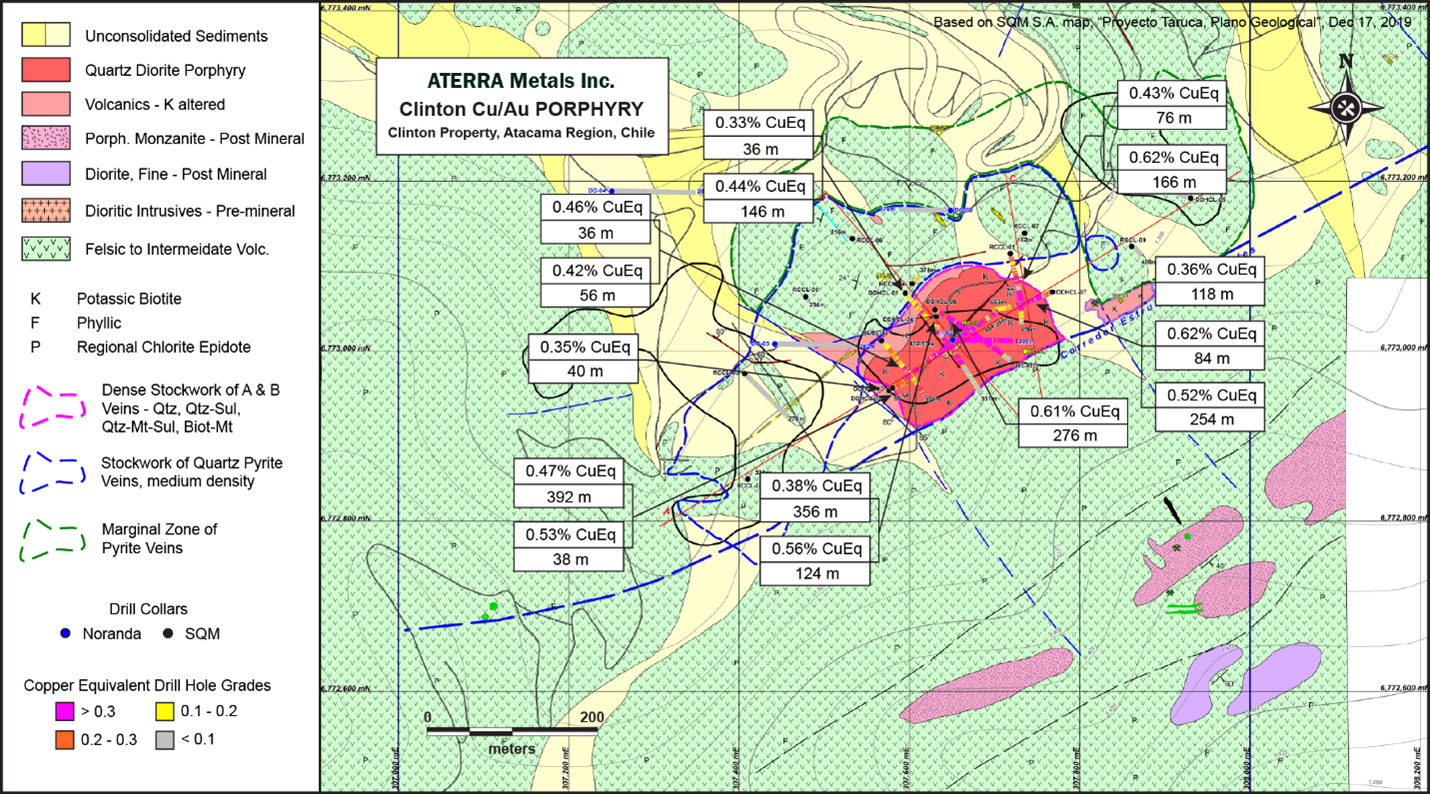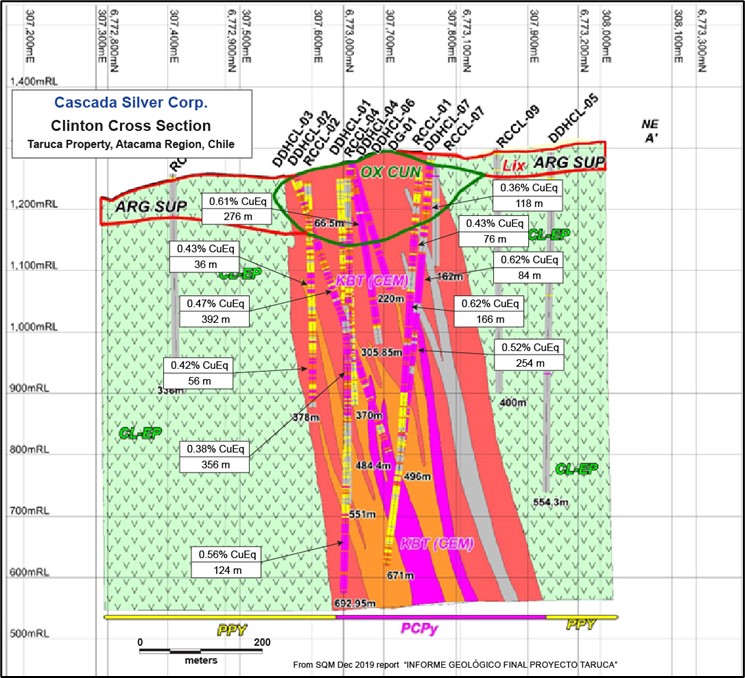
The Clinton copper-gold porphyry is hosted within an altered quartz diorite intruded along the regional Pajonales Fault. During 2018-2019, Sociedad Química y Minera de Chile S.A. (“SQM”), a major Chilean lithium producer, drilled 6,194 metres outlining a mineralized porphyry extending to downhole depths of over 500 metres. A summary of the assay highlights from the SQM program is presented in the table below. Despite the significant drilling completed, no resource estimate has been prepared for the Clinton porphyry.
| Clinton Historical Drilling Highlights (SQM – 2018/19) | |||||
| Drill Hole | From | To | Interval | Cu | Au |
| metres | (%) | (g/t) | |||
| RCCL-01 | 202 | 368 | 166 | 0.23 | 0.31 |
| DDHCL-03 | 40 | 432 | 392 | 0.21 | 0.21 |
| DDHCL-04 | 570 | 693 | 124 | 0.21 | 0.27 |
| DDHCL-06 | 0 | 276 | 276 | 0.23 | 0.30 |
| DDHCL-07 | 14 | 132 | 118 | 0.17 | 0.16 |
| and | 156 | 240 | 84 | 0.28 | 0.27 |
| and | 256 | 508 | 252 | 0.22 | 0.24 |
| NOTE: See note on Historical Results and on the calculation of CuEq grades. CuEq grades were composited using a 0.25% cut-off grade and max. 4 metres of internal sub-0.25% CuEq “waste” material. Intervals represent downhole lengths and not true widths. The reader is cautioned against relying on the accuracy of the historical results presented; however, ATERRA considers all historical results to be relevant as those results will be used as a guide to plan future exploration programs: ATERRA considers the data to be reliable for these purposes. | |||||
Clinton Mineralization and Alteration
The SQM drilling showed a system of multiple intrusions, composed of several dioritic pulses, dioritic quartz and monzodioritic, classified as early, intermineral, late and post-mineral. The intermineral porphyries generated a sequence of clast-containing igneous breccias including veinlets from the early porphyries. These multiple pulses, which control the evolution of the hydrothermal system, produced complexity in their identification and temporal separation, since they present similar chemistry in their lithology.
The main copper mineralization is chalcopyrite which occurs in a disseminated and veinlets accompanied by significant gold values (up to 0.7 ppm Au). The mineralization (chalcopyrite-magnetite-gold) is directly related to early mineralization events, which exhibit biotite-magnetite alteration, associated with the presence of a stockwork of EB-type biotite-magnetite-chalcopyrite veinlets cut by A-type quartz-chalcopyrite-magnetite veinlets. Grades ranging from 0.3-0.7 g/t Au and 0.15-0.40% Cu.
Intermineral porphyries exhibit disseminated sulphide mineralization and in EB-type (biotite-magnetite) and A-type (quartz-chalcopyrite-magnetite) veinlets; occasionally there are type B veinlets (quartz-pyrite-chalcopyrite-molybdenite). The copper and gold grades associated with the intermineral porphyries are lower ranging from 0.1-0.3 g/t Au and 0.1-0.2% Cu. Late porphyries contain very little disseminated chalcopyrite mineralization, with grades containing up to 0.1% Cu.
On the surface of Clinton, an area with dense quartz-magnetite-biotite-goethite stockwork veining is associated with a biotitic potassium core of approximately 220 x 130 m generated by the multiple intrusions. The alteration observed in the potassic core is composed of minerals such as biotite, quartz, magnetite, retrograde chlorite, epidote, albite and scarce K-feldspar, in different associations related to each intrusive pulse.